Dental implants
Dental implants
Dental implant care tailored to your needs
At Clinique Apolline, we take a patient-centred approach to implant dentistry, with the aim of restoring chewing function while also taking aesthetics into account. Our clinicians tailor each treatment plan to the patient’s anatomy, oral health, needs and expectations, with particular attention to comfort throughout the course of care.
At Clinique Apolline, you will be looked after by experienced dental professionals who pay close attention to every stage of treatment. Our objective is to provide high-quality implant care in Brussels, with a focus on function, aesthetics and long-term maintenance. The outcome and longevity of an implant depend on several individual factors, including oral hygiene, general health, smoking and regular follow-up.
When might dental implant treatment be appropriate?

If you answered yes to one or more of these questions, this page explains when dental implant treatment may be considered and how it is carried out at our clinic in Brussels.

A dental implant is an artificial tooth root: a small fixture, usually made of titanium or a titanium alloy, that is surgically placed in the jawbone. Titanium is widely used in medicine because of its biocompatibility and its ability to integrate with bone.
A single-tooth implant restoration generally comprises three components: the implant, an abutment and a custom-made crown that recreates the visible part of the tooth. Together, they are designed to restore the appearance and function of the missing tooth while respecting your anatomy.
When one or more teeth are missing, implant treatment may provide a fixed and stable solution, subject to a full clinical assessment.
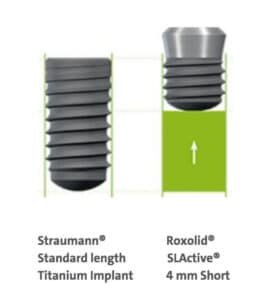
At Clinique Apolline, we use the Straumann® Roxolid® SLActive® implant system, selected for its materials, extensive scientific documentation and established clinical use in implant dentistry.
Numerous implant systems are available, with differences in design, materials, surface technology and supporting clinical evidence. As these differences are not always apparent to patients, we prioritise systems with well-established documentation.
We do not base our choice on price alone. We consider the quality of the components, the available evidence, suitability for the individual case and access to compatible parts for long-term maintenance.
Clinique Apolline has therefore chosen Straumann® dental implant systems, known for their quality and supported by a substantial body of scientific research.
After a comprehensive clinical and radiographic assessment of aesthetics, function and bone volume, implant placement is usually carried out under local anaesthesia.
The clinician responsible for your care will first assess the available bone and select the most appropriate implant and treatment protocol. Local anaesthesia is used to minimise discomfort. Depending on the number of implants and the complexity of the procedure, treatment may take from approximately one hour to several hours. During treatment, you may feel pressure or vibration. Temporary soreness or swelling can occur afterwards and varies from person to person.
Because implant treatment can involve different procedures and components, a single fixed price would not be accurate.
Each situation is different. After assessing your oral health, treatment goals and radiographs, we determine whether additional procedures — such as bone grafting or a sinus lift — may be required. You will then receive a personalised treatment plan and a clear fee estimate before treatment begins.
The biological healing phase follows implant placement: the surrounding bone needs time to integrate with the implant, a process known as osseointegration. The time required varies according to bone quality, implant stability, the surgical protocol, general health and other individual factors. In selected indications, studies of the Straumann® SLActive® surface have supported early-loading protocols after around 3 to 4 weeks, compared with conventional healing periods of 6 to 8 weeks. This does not apply to every patient; your clinician will determine when it is appropriate to proceed with the restorative phase.
An appropriate healing period is therefore essential and will vary according to your clinical situation. The Clinique Apolline team will explain the precautions to follow and remain available if you have any questions during recovery.
During the first few days after surgery, the following general recommendations should be observed:
- Maintain gentle but thorough oral hygiene, following the instructions provided
- Avoid touching the surgical area or anything that may increase the risk of infection
- Choose soft foods during the initial healing period
- Do not smoke during the healing period, and avoid alcohol for at least 24–48 hours or for as long as advised by your clinician
Why do we use Straumann®?
To support a carefully planned treatment pathway and a comfortable recovery, we provide attentive follow-up from the planning stage through to the final restoration. Our choice of implant system is guided by two important clinical considerations:
1 – Osseointegration: this is the biological process by which the jawbone forms a stable connection with the implant after placement. Successful integration is essential before the implant can support its final restoration. The timing and predictability of this process depend on bone quality, primary implant stability, the implant site, general and oral health, and follow-up care.
2 – Long-term implant survival: this refers to the implant remaining functional over time. Published studies of specific Straumann® Roxolid® SLActive® implants and protocols have reported survival rates of approximately 99% in certain study populations and at defined follow-up periods. This figure is not a guarantee of an individual outcome. Long-term performance depends not only on the implant system, but also on diagnosis, placement, the final restoration, oral hygiene, smoking, general health and regular maintenance. Straumann® systems are supported by long-term clinical data, but no implant can be guaranteed to last for a specific number of years.
At Clinique Apolline in Brussels, we favour well-documented implant systems and careful treatment planning. Our aim is to provide a restoration tailored to each patient’s needs, with appropriate attention to function, aesthetics and oral health.
Our team remains available throughout treatment and follow-up. The long-term outcome also depends on the patient’s oral hygiene, maintenance appointments and individual risk factors.
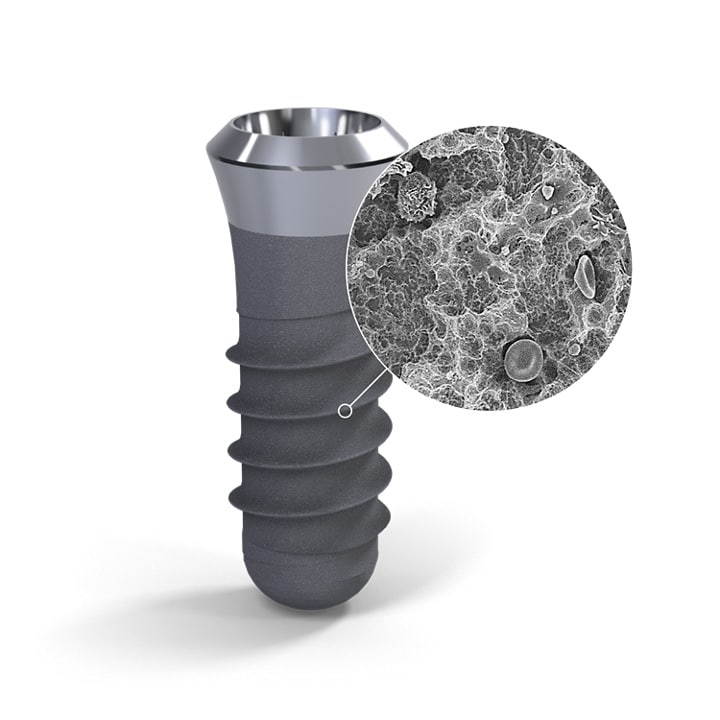
The SLA® surface is produced by coarse-grit blasting, which creates macro-roughness, followed by acid etching to create micro-roughness. This surface topography is designed to support bone-to-implant contact and osseointegration.

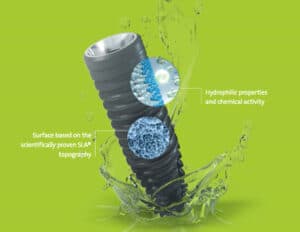 SLActive® is a chemically modified, hydrophilic implant surface designed to promote early osseointegration. It has been investigated in immediate and early-loading protocols, including situations in which implant stability is clinically important. It is a feature of the Straumann® Dental Implant System.
The SLActive® surface may support earlier loading in suitable clinical situations.
According to Straumann’s supporting documentation, the healing period may, in selected cases, be reduced from 6 to 8 weeks to approximately 3 to 4 weeks. Your clinician will determine the appropriate timing for your treatment.
It is designed to improve predictability in protocols where implant stability is critical.
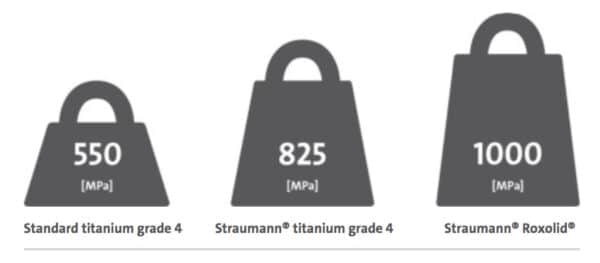
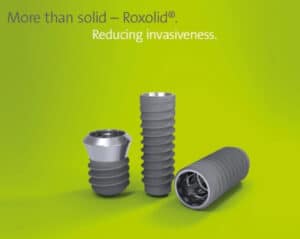 Roxolid® is a high-performance titanium-zirconium alloy developed to offer greater mechanical strength than commercially pure titanium while retaining properties that support osseointegration. In selected cases, this may allow the use of smaller-diameter implants.
Small-diameter Roxolid® implants can broaden the available treatment options in carefully selected cases, following a full clinical assessment.